Embracing Adaptive and Inclusive SUP
Jo Moseley

Hello, my name is Jo Moseley, and I am the author of Stand Up Paddleboarding in Great Britain – Beautiful Places to Paddleboard in England, Scotland and Wales and host of The Joy of SUP – The Paddleboarding Sunshine Podcast. I am also a proud ambassador for the 2 Minute Foundation and Seaful Charity.
Embracing Adaptive and Inclusive SUP

I’m so grateful to Mark at Shoretees SUPwear for highlighting WhatSUPUK and my next story for you when we chatted at Lake District Paddleboarding’s SUPFest in the Lake District a few weeks ago.
Mark kindly introduced me to Ben Peters, an explorer who has paddled the Blue Nile and in the Amazon and is the founder of WhatSUP Ltd, so we could chat further. WhatSUP began in 2017 and is a community of highly qualified and dedicated instructors committed to using the power of SUP to help others and make it more inclusive. A percentage of every booking for a SUP lesson is put aside so they can do this sustainably. They offer free or discounted SUP lessons to disadvantaged groups who could otherwise not afford them.
When we spoke, Ben told me about the Embrace board he had designed. The Embrace is the first wheelchair-adapted paddleboard in the UK, initially allowing them to offer adaptive paddleboarding in Somerset. They have since trained other SUP schools across the UK and supplied them with the same equipment.

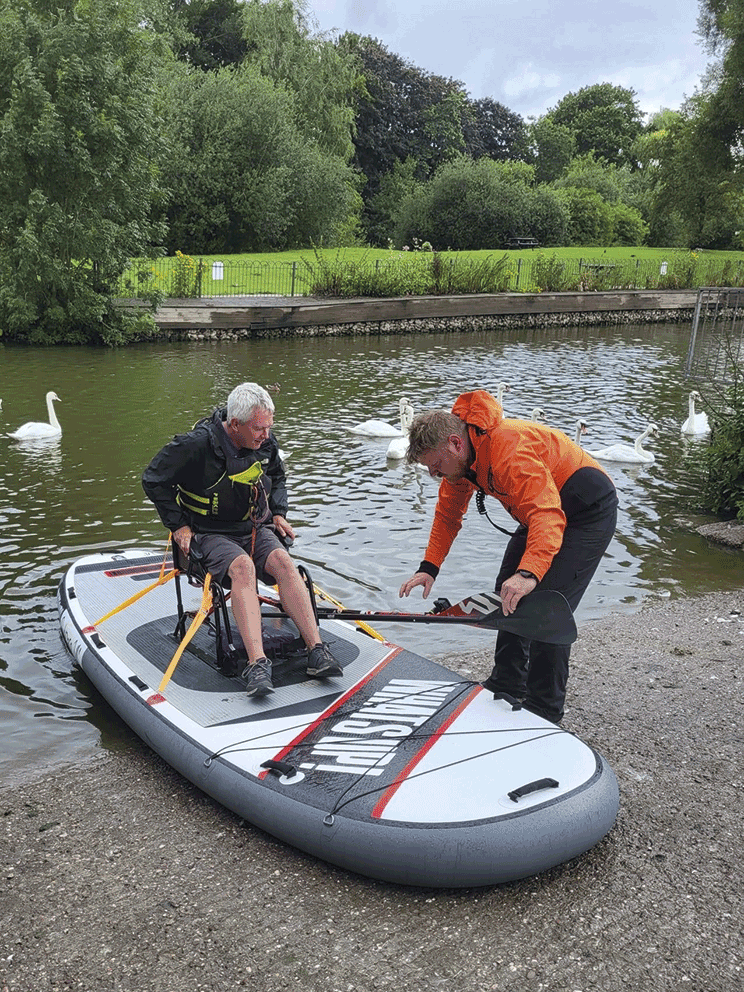
WhatSUPUK manufactures several other boards, and this is the one they are most proud of for the opportunities it offers wheelchair users. It has anchoring points for specially designed adapted chairs and sidekick boards (similar to ‘stabilisers’). The boards are not sold directly to individuals. However, many schools nationwide use them, including SUP Active Yorkshire in Richmond, Yorkshire, The Anderton Centre in Chorley, Lancashire and Whitemoor Lakes in Lichfield, Staffordshire.
WhatSUPUK also provides paddleboarding opportunities for foster families to spend time on the water to get to know each other.
For more information, go to www.whatsupuk.com

 SUP Mag UK
Hello
I’d like to know how I can support inclusive paddle boarding? It’s a lived experience thing.
Here is my story:
What Stand Up Paddle boarding means to me
Hope it inspires you all the believe if you try hard, learn from your setbacks, then try again, you can do anything, trust me! 💡
At 39, I was a 70 mile a week fell runner with three kids aged 4,8 &10 and ran my own marketing business with a remote, serial philandering/controlling ex-husband.
I was under huge stress trying to please everyone and run the home and work, which is why I had the worst type of brainstem stroke imaginable with Locked In Syndrome, it wasn’t genetic.
A condition where for months I could only think, feel, fully understand and see everything but move nothing below my eyelids.
Think buried alive and you’ll get the idea.
I wrote my internationally published book ‘Running Free: Breaking out of locked in syndrome in 2011’. (Amazon)🤣
I’ve spent years helping people like me improve after their young strokes worldwide with the registered charity I founded, and now inspire and train the NHS leadership and clinicians to improve how they deliver personalised care and therapy to people with stroke.
Until I discovered that my own happiness cannot be found by only voluntary helping people all the time, as noble as it was.
I did my self-development during lockdown and realised I became very depressed because COVID prevented me from giving to others. But my expensive divorce meant I also needed to earn money!
I realised my own true happiness shouldn’t only be determined by the gratitude of others after helping them.
So I set about thinking about the stuff that made me smile – photography, music, podcasts, learning to play Wonderwall on the guitar, the smell of freshly laundered sheets…
Years later, I read an article about stand up discover paddle boarding and thought well that looks great but I won’t be able to put on a wetsuit on my own; even brave the UK water temperatures; climb on the board; kneel on it let alone stand on it!
I convinced myself that if I didn’t manage to stand I would feel a failure. Which of course is NOT true anyway. I’m a survivor/thriver.
(I’m very competitive with myself by nature and extremely determined, hence why I recovered 14 years ago when doctors wanted to turn off my life support machine.)
But with wonderful teaching, patience and adapting my standing technique, due to my balance issues, I achieved everything and quickly!
Paddle boarding is my happy place. It’s relaxing, social, peaceful and allows me to combine my love of photography with a sport I have become obsessed with.
I want to develop and improve inclusivity in paddle boarding in the UK with my lived experience ideally in a formal capacity long term, because there is nothing more powerful and inspiring as peer mentors for other people who are disadvantaged by the roller coaster of life.
Could we speak?
Kate
LikeLike