SUP freestyle – the fun way to improve your flat water paddling
SUP freestyle by Tez Plavenieks
Words & photos: Tez Plavenieks
As a new stand up paddleboard owner, following a few sessions meandering about, there’s often a question of where to take your SUP next. Adventure paddling, SUP surfing, SUP racing and so on are all applicable. But for anyone keen to keep things fun, possibly remain closer to home, yet still improve there’s another option.
SUP freestyle?
As a watersports instructor of many years, I was always conscious of getting my groups to progress, learn new skills and push on. But without being ‘drilled’. There’s nothing worse than feeling like you’ve ‘been to school’ (so to speak) when doing something that’s supposed to be fun. Which is why during all my coaching sessions I’d aim to come up with some kind of game or alternative method of teaching rather than simply making students learn a new skill.
Just like anything stand up paddle boarding has its own set of techniques. The more you learn and can do the better your overall experience will be. That also knocks on to the additional paddling environments and weather conditions you can cope with.
Keeping both the above elements in mind SUP freestyle is a fun way to get on top of new SUP skills – both board handling and paddle related. It’s nothing new as back in the day many of us discovering SUP pre-2010 were seeing what could be achieved whilst standing atop a paddle board. Spinning, whirling, twisting and walking up and down the ‘plank’ helped us identify just how far we could push the performance of the gear being used whilst developing muscle memory and paddle/board handling skills in tandem.
The word ‘freestyle’ may conjure up some images of elitist moves being carried out but actually it’s just a term that means messing about. There’s nothing more to it than that. Anything that you do aboard your SUP, other than actually standing and paddling, can be classed as SUP freestyle. If it means you’re moving about proactively and developing your skills, but in a fun way that’s also engaging in its own right, then that’s all good in my book.
A few simple SUP freestyle moves to try
Depending on how confident you are there are a few SUP freestyle moves you can try to set the ball rolling. You don’t need to aiming for the most difficult straight off the bat. Of course, if you want to, then go for it! I will also say that these manoeuvres are just suggestions. The other element to SUP freestyle is creativity. You’re free to come up with your own tricks. There’s no right or wrong with this. You will probably get wet. In fact, if you don’t take a dunking then you’re not trying. But the more you try, and the more you fall, the more skilled a paddler you’ll be with a broader repertoire of ‘tool’s you can call upon.
Tail sink pivot turn
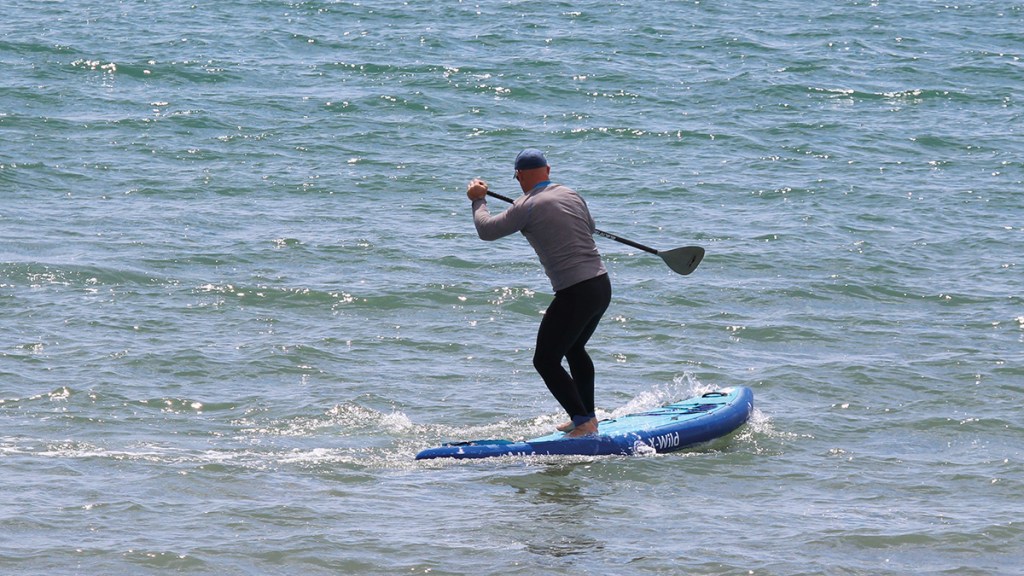
The tail sink pivot turn is one of the most fundamental skills in SUP. Stepping back to the tail of your board, sinking it and raising the nose whilst putting in a wider sweeping paddle stroke will see your SUP spin on a dime. Your aim is to see how deep you can sink the tail (and raise the nose) yet still make the turn dry. It’s a great skill to have. SUP surfers use it regularly to pivot onto waves they want to catch without going wide of the peak. And SUP racers often use the move to spin round buoys quick smart. There’s plenty of practical use for the tail sink pivot turn.
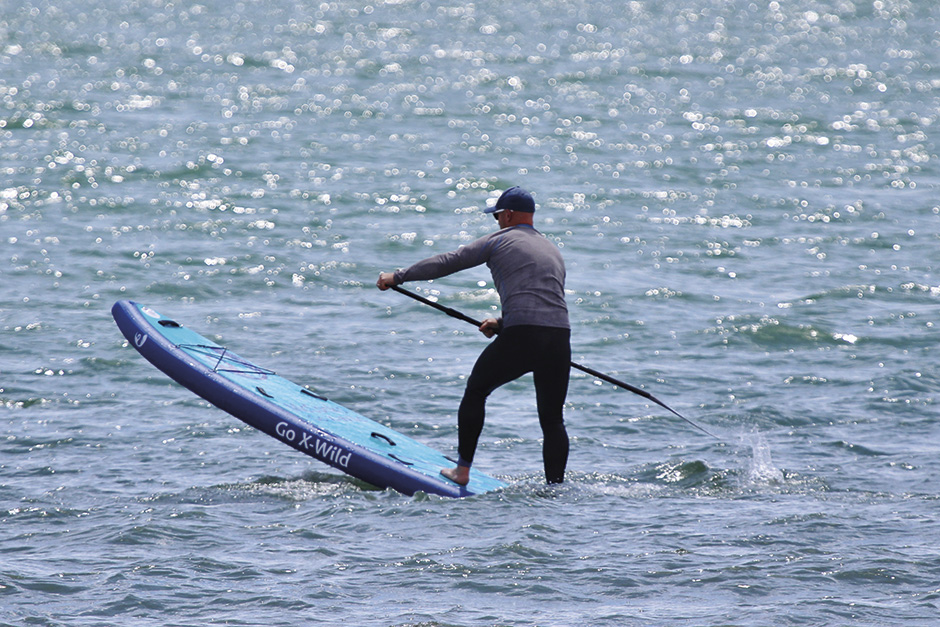
Tail sink pivot turn
Nose sink pivot turn
Just like the tail sink version the nose sink pivot turn requires the paddler to walk along their SUP to the front, turn back towards the tail and do exactly the same movement. Sink the nose, raise the tail and pivot 360. The only difference here is you haven’t got the stability of a fin in the water. That makes your SUP feel looser and more slippery. You’ll probably have to use a few brace strokes the first few times to avoid getting wet. But this is a good thing as you’ll intuitively be learning what a brace stroke is.
Toes on the nose
Perhaps before learning the nose sink pivot turn walking the board and getting your toes as far over the nose as possible is worth practising. Deft footwork is key here. But after a few goes you’ll surprise yourself just how far you can get.
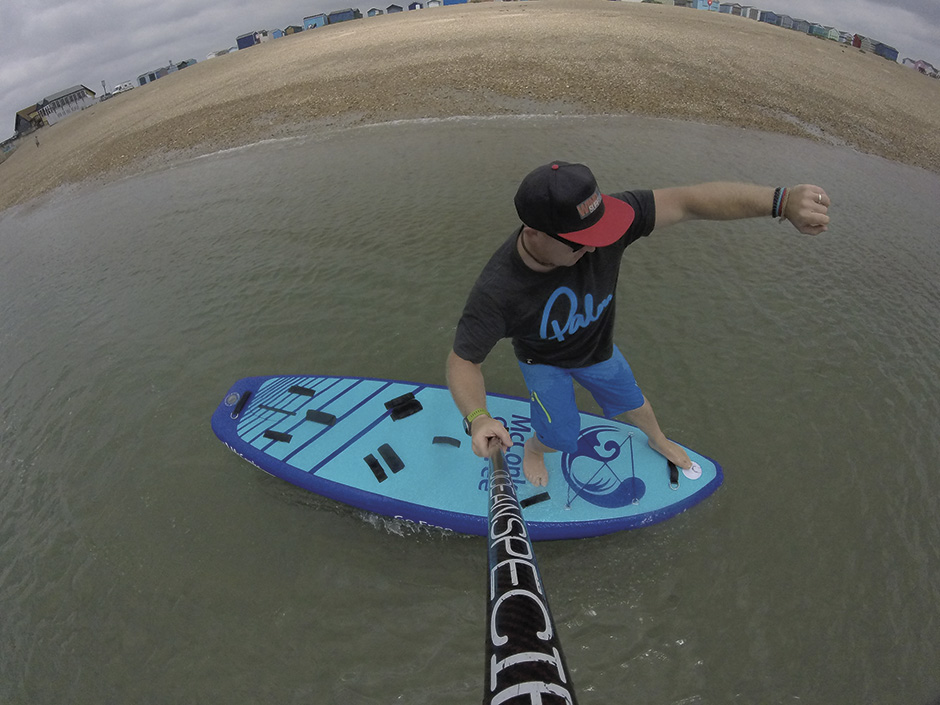
Toes on the nose
Paddling fin first
If you’ve had some time playing with moving about your SUP not using your paddle a fun exercise is to get on the board’s nose, turn to face the back, raise the tail so the fin clears the water by sinking the nose and then paddle your board that way. As with the nose sink pivot turn you’ll not have the directional stability of a fin so it’ll force you to use various paddle strokes to remain straight and true.

Paddling fin first
Body and paddle 360s
For the body and paddle 360 you’ll be jumping into the air, on your normal paddling spot, and spinning 360. The aim is to land back on your board, in your paddling stance with the board remaining as flat as possible. You may find a 180 is more achievable to begin. In which case practise that before heading for the full twist.
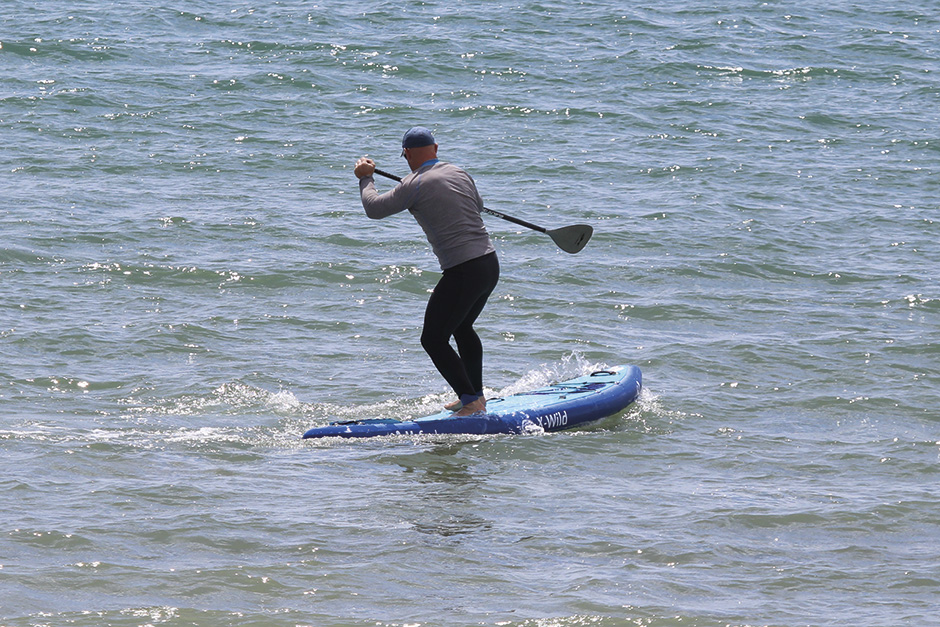
A board 360
Pilot your SUP upside down
Flipping your board onto its deck, standing on the hull (fin up) and paddling this way is amusing. It forces riders to focus on their footwork as with no deck grip the hull’s PVC bottom is akin to an ice rink. Also, your SUP’s rocker isn’t designed to be paddled this way so you’ll need to employ some positive paddle strokes to push it forwards.
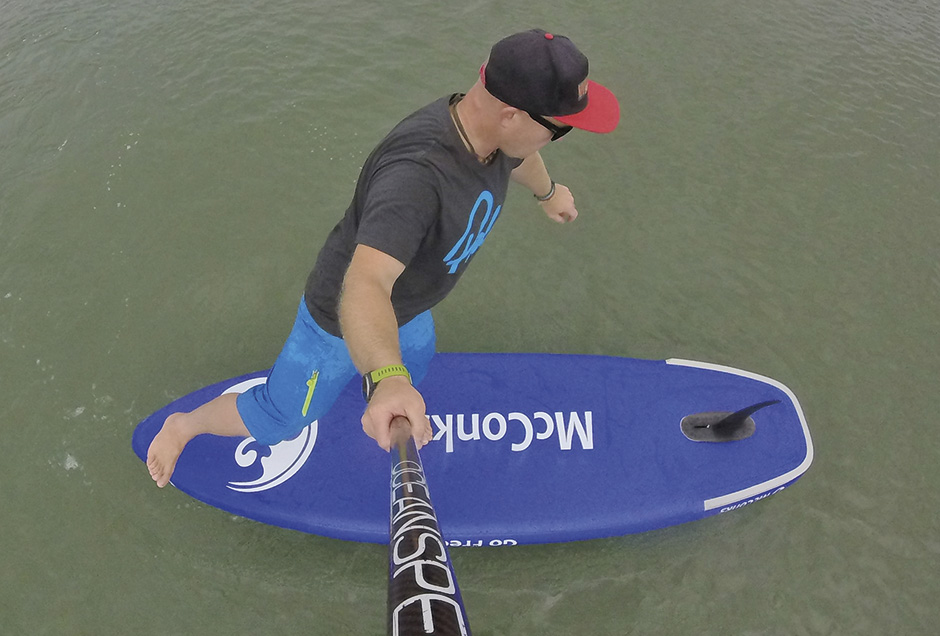
Paddling fin first, upside down with one leg in the air
Paddle one legged
This is a great one for improving your overall balance as well as forcing you to rely on your paddle more. It’s also slightly trickier than it looks. Once you’re comfortable and in your normal paddling stance take one foot off the deck. As you get better and more confident you’ll be able to raise your leg higher and stay like this for longer. Using your paddle as a ‘crutch’ is one way to stay dry.

One legged paddling
Combo moves
If you can do any one of the above (or something you’ve come up with yourself) it’s great to try and combine some moves. Maybe get a SUP freestyle repertoire going where the idea is to flow between tricks – without falling. As an example you could try walking to the board’s nose and paddling backwards with one foot raised before running back to the middle and spinning 180. That’ll certainly get the giggles going as well a few splashes!
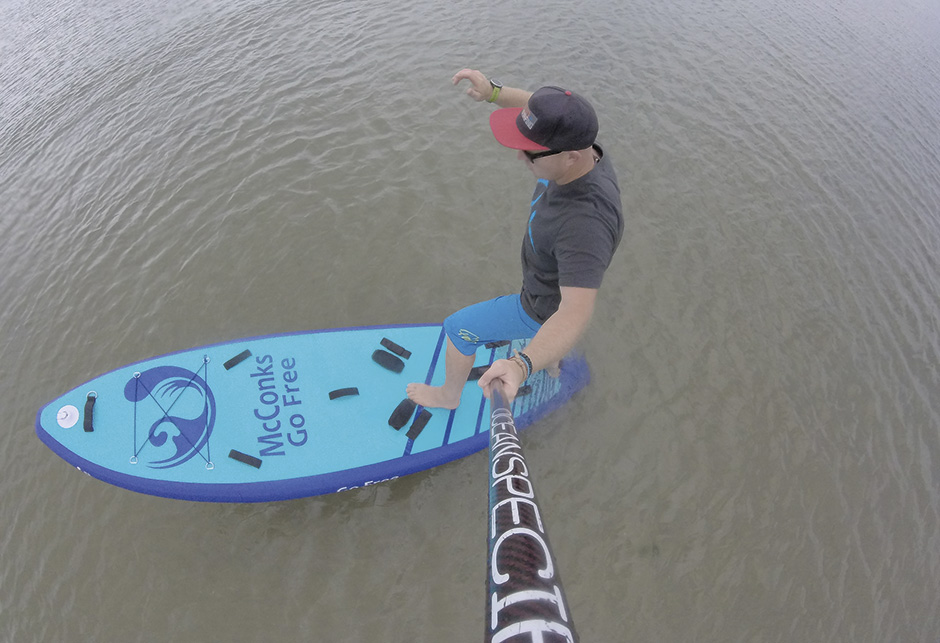
One footed tail sink pivot turn
There’re no limits to how creative you can get with SUP freestyle. And as I said at the start of this article it’s a way to potentially spice up your regular flat water paddling sessions as well as improve your overall skillset. Have a play and see what you can come up with!

 SUP Mag UK
Hi,
I’m interested in trying g freestyle SUP. It seems to me that freestyles have shorter boards. My boards are 12 and 14 foot. Does that make a difference?🤙
Michele
LikeLike