Don’t stop moving – SUP and Parkinson’s with Rob Britton

Words and photos: Rob Britton
Foreword: Tez Plavenieks
I’ve also windsurfed and paddled with him as well. To say I was shocked when he received his Parkinson’s diagnosis is an understatement. I’m not that much older. Knowing Rob wanted to help raise awareness and show Parkinson’s isn’t something that only affects the older generation, I contacted him to see if he’d be keen to do this article. He was. So, here’s Rob’s story. Thanks for telling it, Rob.
How long have you been into watersports, and where does SUP feature?
I’ve been involved in water sports since a very young age. Living in Gloucestershire, we were close to the River Avon and Severn. These two rivers offered the chance to use canoes or sailing dinghies during weekends and holidays. Allowed this freedom at a young age was embraced and respect for the water became second nature. At 16, I decided that the leisure industry would be an excellent avenue to pursue. The foundation of being around the water while growing up supported me on my journey as a water sports instructor. That qualification was the golden ticket to opening opportunities to work overseas doing something I loved! The foundation of being around the water, while growing up, supported me on my journey as a water sports instructor and opened opportunities to work overseas from 1996 – 2002.
2002 my seasons overseas finished, and we had set up a home on UK’s south coast, Gosport. Work drifted away from the watersports industry, a family was started, and the age-old balance of family, work and hobbies commenced. Sessions became sporadic and a small family car, not supporting a stack of windsurfing gear, steered me down the kiting route. Kiting lasted a year, and I found myself at the front of a Shearwater Sailing Catamaran.
2020, the COVID lockdown stopped any travel plans and presented challenges for carrying out activities. As we had the water on our doorstep, SUPing was the answer and this readily available activity saw ownership of one SUP turn to three.
When did you start paddling, and why?
I’m very much a late adopter of paddling. I was working at a trade fair in Birmingham circa 2004. On our stand, we had a stand-up paddleboard. I recall thinking it looked interesting but was sceptical also storage of another board was not on the cards. I recall thinking it looked interesting but couldn’t justify another toy, and where would I store it with all the other toys in the shed?
Fast forward to 2020, and SUPing appeared to be everywhere. The performance of inflatables seemed to be at a standard that couldn’t be sniggered at, which removed the excuse of being unable to store and transport. The concept appeared to be one not to turn your nose up to.
I was in my local watersport shop, returning to windsurfing. A lot of kit was being procured, and I was nervous about what the reaction would be on my return home. Then out of the corner of my eye was an inflatable touring board from STX.
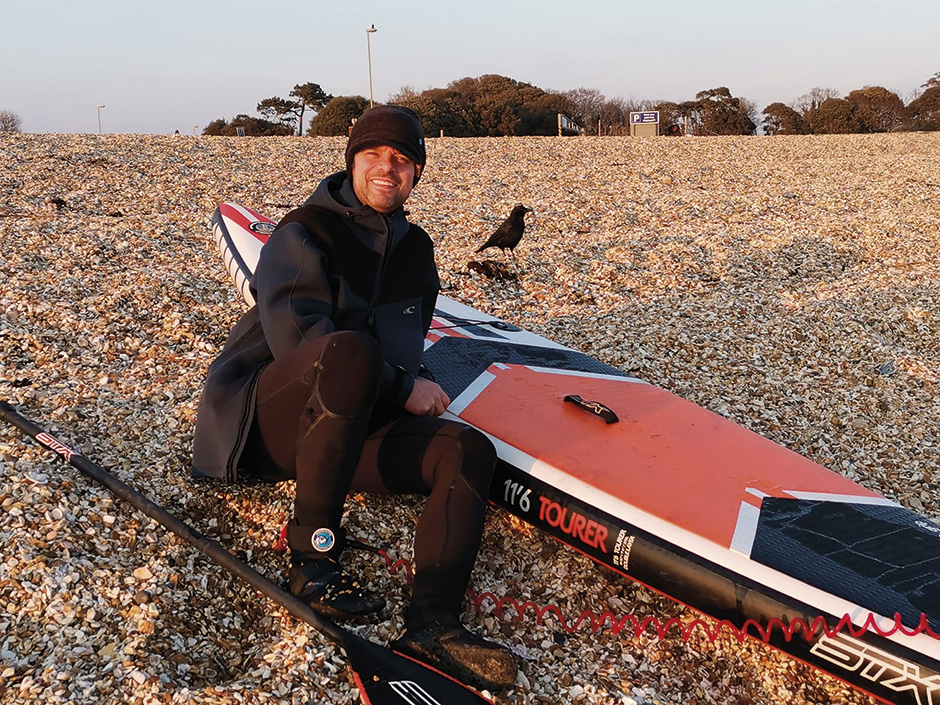
The shape caught my interest and the affordable price. The first family SUP was procured! On arrival home, the reaction to the introduction of the board was positive. The decision had been the right one.
At the time, we were in the initial throes of COVID, and activities close to home were welcomed. Use of the board became more and inevitably, the family discussions of who would use the board and how long crept in. A few weeks later, I was back at my local watersports shop procuring the second family SUP. This time I went for an inflatable wind SUP from STX. The shape this time was like a surfboard. The opportunity to use a windsurf sail with the board intrigued me and justified the purchase. The board would be able to accommodate different interests.
Summer of 2020 and COVID was well established, and the opportunities to go far and wide were minimal. The two SUPS were being used regularly, and now other families were interested. Helping friends out with sourcing an inflatable SUP, I came across a Facebook marketplace advert for two STX touring SUPs. One went to the interested family, and the other joined our two SUPS. The SUP fleet was complete!



How does SUP fit your and your family’s routine?
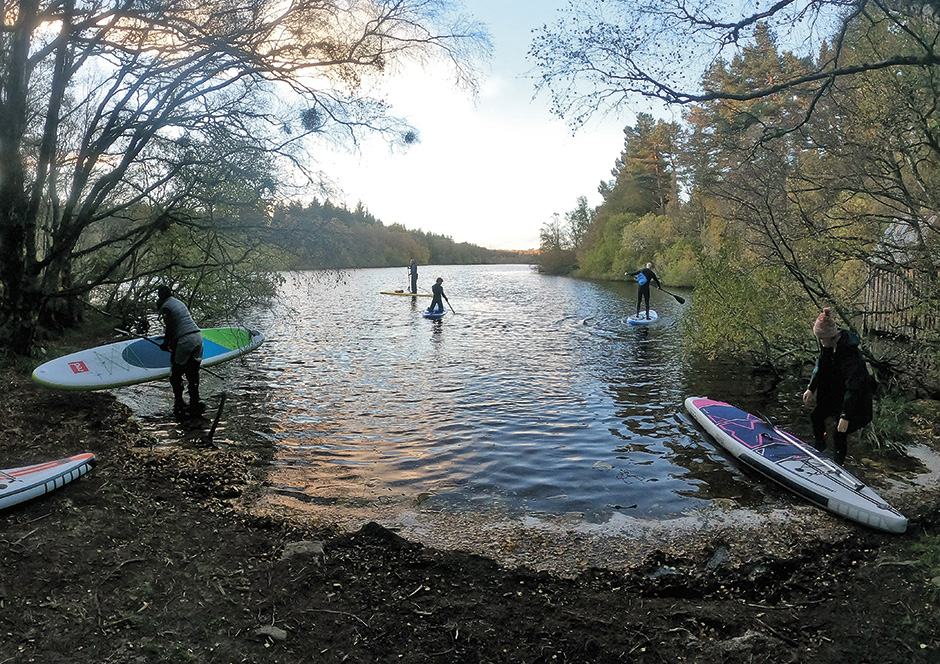
Having inflatable boards aids transportation. Trips to the beach will see the addition of a board, or two, being thrown in along with the BBQ and chairs. The same goes for holidays. A Scottish trip to the Highlands saw us taking the boards with us and, with local knowledge, used to explore local lochs. Trips to Saunton Sands will see at least one SUP loaded. Strangely enough, the touring STX is favoured for catching waves on the beach.
This year’s family holiday, shared with family friends, SUPS will be on the cards to be packed. We are looking forward to exploring the coastline of Pembrokeshire and playing about in the surf alongside our surfboards. The boards add that extra element to a holiday at no extra cost for an activity when away.
Where do you usually paddle?
In our location, we are lucky. We are based on the north shoreline at Gosport. From the back garden to the water, it’s a 10-minute walk. Apart from no shore break, Portsmouth Harbour has so much to offer and explore.
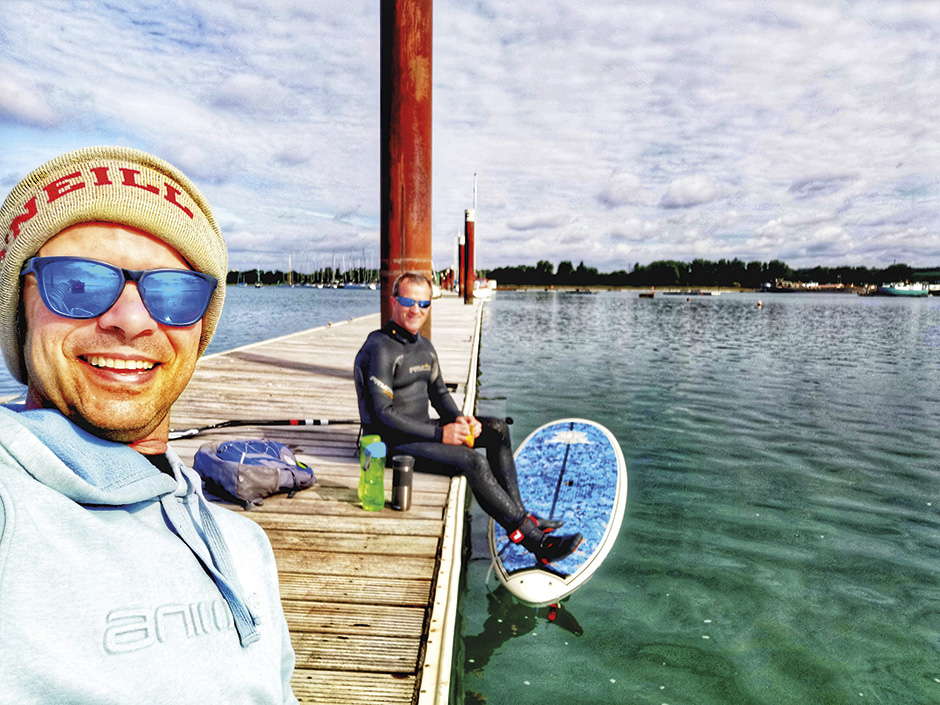
Tide-dependent, you can paddle up to Fareham and back to get the miles in. Paddle across to Portchester Castle, or if you feel very adventurous, paddle past the ferries and into the tidal lake at Alverstoke. This route is challenging due to the water traffic but achievable.
We’ve also launched from Portchester Castle and enjoyed an evening of wind SUPing on the boards. The performance of the boards always surprises and on light wind days when windsurfing is not viable. Those that challenge the boards on upwind performance are proven wrong. Very versatile!
Got any particular SUP locations to tick off, home or away?
Pembrokeshire has been one location that has intrigued me – with a trip planned this year happy to report back.
The Scottish trip scratched the surface of what can be explored. The west coast has loads to offer (not including the midges).
One SUPing location I won’t be exploring is that of running a rapid. During a trip to Scotland, we went white water rafting, and we saw a group making their way to the river on leaving the riverbank. Imagine paddlers kitted out in American football attire with inflatable boards under arms.
Talk us through your diagnosis. When did you realise something wasn’t right and what were the steps that followed?
Summer of 2019, I was walking with my wife. A nice day out, and all was good in the world. “What is wrong with your left leg?” Angela, clearly frustrated, asked, “You’re dragging it.” As far as I was concerned, there was nothing wrong. End of that conversation.
A couple of weeks later, we are on Saunton Beach, ready to go surfing with family and some of our extended Sunsail family. Everyone was rushing to get in the water, but I was struggling to put my wetsuit on – a moment that had been lovingly filmed for prosperity.
At the end of the session, I realised I was the last one in the water. I started the long walk back to the dunes, board under the arm. “What is wrong with you? You look like an old man walking up the beach,” was the greeting I was met with on my return. Considering I’m the youngest in my group by a few years, this was a kick in the *. I couldn’t deny it. Something was not quite right with my left side.
After the holiday, I booked a doctor’s appointment. Expecting to be told I had fallen arches from wearing flip-flops and a frozen shoulder, I was surprised that the appointment lasted five minutes. The doctor had taken one look at me and returned the verdict that I needed an urgent visit to a Neurology department.
My neurology appointment turned into more than one visit. For three weeks, I was questioned, scanned many ways, tested, prodded, and given some test medication. All very over the top for a frozen shoulder and fallen arches.
On 21st November 2019, I had my results appointment. The appointment started with more tests – which showed a lack of performance from my left side. My consultant then proceeded with, “My diagnosis of your condition based on all the test results is Parkinson’s – you have a condition called Young Onset Parkinson’s Disease.” What? How? Why? Me? Cue complete shock, utter disbelief, and denial!
My consultant explained that the challenge is that identifying characteristics are not always present for each sufferer. Which, in turn, doesn’t help a newly diagnosed sufferer understand what is going on. The Q&A, during the month of testing, alongside the scans, confirmed the diagnosis. “Have family or friends noticed a change in how you carry out tasks?”
In follow-up appointments, I learned that Parkinson’s Disease is a brain disorder that causes unintended or uncontrollable movements, such as shaking, stiffness, and difficulty with balance and coordination. Other symptoms may or may not appear, but you get the picture. Parkinson’s symptoms usually begin gradually and worsen over time.
My diagnosis was in 2019, but I would have been in decline before then. This feedback has helped me put an answer to several situations where I couldn’t explain a struggle to carry out simple daily tasks.
How has this impacted your life in general?
People mainly identify Parkinson’s Disease as affecting older people with involuntary shaking of body parts (tremor), slow movement, and stiff and inflexible muscles. Not all sufferers follow these traits. I’m 44 years old, and Parkinson’s mainly affects my left side with slow movements, rigidity, and stiffness. My right fingers have a slight tremor when meds are wearing off. My right leg and toes are prone to Dystonia – my leg literally twists inward to the point where my toes curl in on themselves. This can last from 15 to 30 minutes. During this duration, I’m practising techniques to combat this, swallowing meds and returning the limbs to normality which is exhausting.
These symptoms, and preconceived mindsets, have made me very aware of my surroundings and the situations I find myself in. I have learnt that certain stress and anxiety levels can act as trigger points for symptoms to manifest. Packing and paying for shopping during a busy period at a shop will make anyone anxious, and stress levels rise, but the added symptom of Parkinson’s Disease is not required. Slowness and rigidity are not helpful. Scan and Go options are a big thumbs up!
Parkinson’s traits can also be misinterpreted. To onlookers, these can be perceived as intoxication – ‘one to many’. I’ve had numerous occasions when I have had mates under each arm carrying me out of a venue with onlookers looking on.



What support are you getting regarding Parkinson’s?
The support has been overwhelming on all fronts – family, friends, NHS, and work.
Daily my wife and family kick my butt and support me in activities to keep me on the right track and being me. I get the impression that it’s for a personal gain of silence and reduced hassles with me out and about.
The NHS has me seeing a consultant regularly throughout the year. I have a nurse who specialises in Parkinson’s, on standby, via email/phone. I’m about to have a physiotherapist specialising in neuro conditions assigned to me – I’m expecting my butt to be kicked into action with this recruitment.
On the work front, through health plans, I’ve had two rounds of counselling offered, each lasting roughly eight sessions. The counselling has really assisted me on the journey with tools and techniques to manage scenarios.
What’s been the hardest thing about the whole situation?
I’ve gone from a healthy 40-year-old that would knock out 100 miles on a road bike for kicks, dance until there was no one left on the dance floor, and competitively crew on a catamaran, among many other activities, to a completely opposite person. Slow, stiff, and shuffling.
Any advice you’d give to others in a similar situation?
Don’t stop moving, don’t stop talking, work on a positive attitude, listen to the advice given and keep in the moment, however exhausting. Take any opportunity for help – I’m bad at this, but when I overexerted on the water or mountain biking, having mates to help is a relief, so appreciated!
How does SUP and watersports help?
Exercise is one of the key factors when combatting the symptoms of Parkinson’s. This keeps your fitness levels up, enabling you to cope with everyday life, and it helps positivity levels. Add a SUP to the mix, and you have an outdoor gym offering a complete body workout at a location of choice.
One of the many unwanted aspects of Parkinson’s is falling due to rigidity, stiffness, and shuffling.
Strengthening your core muscles now helps keep balance levels in check for the future – at least that’s what I’m telling myself! SUPing offers a low-impact exercise routine, challenging all parts of the body. All achieved as you paddle along, enjoying the great outdoors. Personally, my go-to board for exercise and fresh air is my windsurf board. In the future, I can see an increase in SUPing activities over windsurfing due to physical ability. I’m not one for a gym, so this change of activity option will be a welcomed option.
Plans for the rest of 2022?
Family holidays, time on the water and at the beach. Oh, and at some point, kick training off for the September London to Brighton road bike ride in aid of Parkinson’s UK.
Final thoughts on living with Parkinson’s?
There currently is no cure for Parkinson’s Disease which means the decline, albeit slow, carries on with symptoms worsening over time. Meds give you ‘A’ quality of life. Without awareness of this disease, there would be no, much needed and appreciated support in its various forms, making the journey almost impossible.
My condition will deteriorate, playing sports and tasks frustrating, but taking the medication, using the support available and being around what I enjoy is my aim to keep on ongoing. “I’ve got Parkinson’s, it hasn’t got me”!
Shouts and thanks?
Firstly, and most importantly, my wife, Angela, and my family (near and far). Thank you for your support and patience!
Also, a huge thank you for the support, kicks and words of encouragement to the Sunsail family (too many names to mention, but you know who you are – both far and near). The Shearwater Catamaran family, the group that wouldn’t let Parky stop me mountain biking through a purchase of a one-handed braking system. Biking Boyos, Buellers Bikers, BBQ Dads, all that I have sailed with at Stokes Bay these last years (Wayne, I will use my foil…), Andy Biggs in the procurement department, work colleagues, NHS, and Tez for this spot to help raise awareness regarding Parkinson’s Disease. A huge thank you to all – everything you do is very much appreciated!

 SUP Mag UK
Leave a comment