Finding the flow state through downwinding

Practice stepping back into surf stance on the flat
Words & photos: Andy Burrows
“Downwinding is the purest test of a paddler’s mentality and their SUP skills.”
Downwinding requires a complete amalgamation of all the skills, knowledge and fitness acquired in other areas of SUP. You need aerobic and anaerobic fitness, the ability to gain immediate power, great balance and agility and superb awareness of the conditions around you. You also need mental strength, courage, patience and resilience.
Do it ‘right’, and the feelings of exhilaration and satisfaction are (to me) the best rush you can get on a 14ft SUP board. You can enter a ‘flow’ state where 100 per cent of your body and mind is focused on the task. You are in control, but without absolute focus, you would be taking a dip in a second. The physical exertion is matched with a mental battle. It’s a long way removed from paddling on a calm lake, chatting with friends, enjoying the views and thinking about where to stop off to eat your sandwiches. It’s a place where you feel alive and in the moment. It’s also a transient feeling that could end with a simple mistake at any moment.
Sounds too dramatic? To discover these fantastic sensations, you need to find conditions that will challenge you, conditions where the heart beats faster when you arrive at the shoreline.
When I am in ‘flow’ on a downwinder, time seems to stop; I feel almost childlike, busy, and immersed in play. I don’t want the experience to end, yet I know that the run will be a memory in a few kms.
How to get into downwinding
Everyone has enjoyed paddling with the wind on their back. It might be tempting to believe that is all there is to downwinding. But nothing could be further from the truth.
The first thing anyone looking to get better at downwinding should do (if possible) is find a mentor. Someone better and more skilled than they are, who will go out with them on some windy days. There is a saying that you don’t know what you don’t know. I have been lucky to train with one of the best paddlers in Spain over the last few years. On the flat, I can stay in his draft. On a downwind, I might average 10km/hr and still end up kilometres behind him. If he was not with me, I might delude myself into believing I knew what I was doing. But watching how he dances on the board, plots his route, selects the waves to catch and remains in total control informs me of how much I still have to learn.
Paddling downwind with someone else is not only safer but also more enjoyable. There is a feeling of camaraderie when you are taking on a challenge together. It gives you additional confidence and helps instil a feeling of playfulness into the whole process.
If you cannot find anyone to paddle with, developing your skills alone is still perfectly feasible. But this should be done incrementally to prevent placing yourself in conditions that exceed your skill level.


What to practice
Moving around the board
You need to move around the board to keep the board on the water and not in the water. This requires the ability to shift your feet into different locations on the board quickly and smoothly. Practising step back turns is an excellent way to tune into how the board changes how it sits on the water with shifts of your positioning.
Power stroke
You need to match the speed of a wave to catch it. If there are only wind waves, then short, frequent strokes will help you take advantage of these. If a swell and faster waves are coming from behind, these must be caught using a more powerful stroke at the point where the nose drops and the board sits on the front face of the wave. You need to engage the feet to inject pace into the board. Once on the wave, keep the nose trimmed and relax. Let the wave take you. Don’t stiffen up or panic because your board is suddenly moving faster than ever!
Both these paddle strokes should be practised on the flat, preferably using drills that build awareness and muscle memory.
Surf stance and offset stance
You need to adopt different stances when downwinding. You can practice this on the flat. This helps to tune you into the board dynamics and makes you more confident when paddling in these positions. As already noted, when you catch the swell, you must ensure the nose does not pitch into the water. (If the nose pitches, it slows the board down, and the wave will slide under you). To do this, you need to move back on the board. How far and quickly to go depends on the height of the wave and its speed. Step back too far, and you will slow the board and lose the wave. Don’t step back enough; the nose will bury itself in the water, and you will stall, or worse, get catapulted over the front! Quite often, subtle adjustments need to be made to keep the nose moving quickly over the water ahead.
Paddling into the wind
If you paddle out to come back, you may be paddling against a 25 to 30-knot wind. This requires its own set of skills and a level of dedication. Maintaining momentum is critical, so the stroke needs a fast recovery and a lower bottom hand to maximise leverage and get the whole body lower to wind.
Where to practice
You can practice downwind skills anywhere
If you don’t have a partner, or the logistics prevent a one-way run, there are still options to gain a downwinding experience.
Onshore wind. Paddle out into the wind for one or 2kms, then turn and head back to shore, practising the skills. This can be great fun.
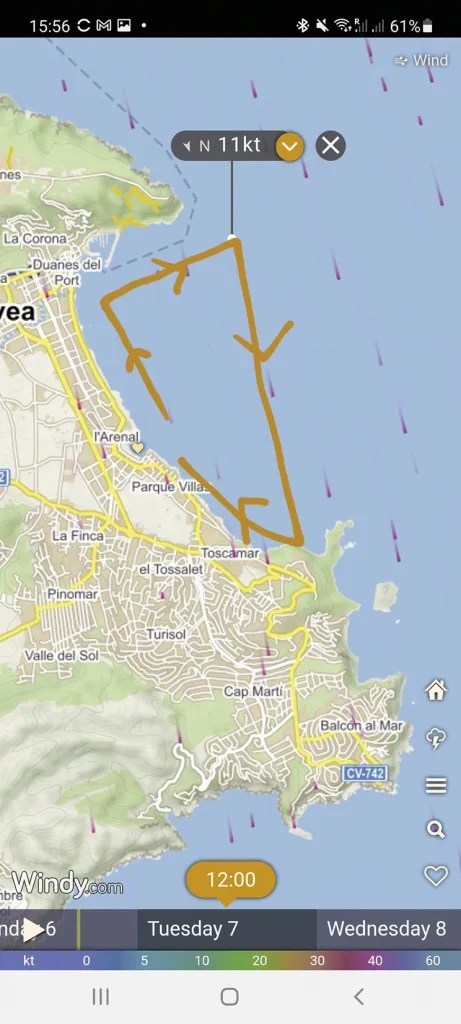
Plot a route that incorporates an element of downwinding into it. I always try to do this when I go out. I’ll check the Windy app, note the direction and strength of the wind and how the swell is predicted to behave and plan a route accordingly.
The sea is the classic place to experience true downwinding (in my opinion), but it is not the easiest. Rivers and lakes offer exciting and easier opportunities to gain downwinding experience. When I paddle in Scotland, I will study Windy, and if the wind is above 15 knots, I will see if I can find a loch that will give me the best downwind run. For example, Loch Tummel runs 11km from east to west. The wind direction is predominantly from the west, so this loch often gets fantastic wind funnels running straight down it. If you want to, you can stand on your board at one end and find yourself at the other in less than two hours. If you bother to paddle and catch the lovely even waves on offer, you can do it in just over an hour.
Things to watch out for
When you paddle on the sea, things are never straightforward. There are many variables at work. The swell may be coming from a different direction to the wind. There may be at least two swell directions. There may be geological features such as high cliffs which create rebounds to contend with. So, these factors all affect the downwind. As you progress, you will get more and more tuned in to how to handle them.
Always use your senses as well as the information from any weather app. Apps can often be wrong, so keep a degree of flexibility in your approach to the paddle.
Always wear layers of clothing appropriate to the conditions. Also, wear a PFD and take a communication device. It is more likely you will fall in, and in more extreme situations, it is not unknown whether leashes will snap or Velcro belts will work free.
Skills that improve over time
The more you experience downwind, the more overall awareness you gain. Your timing will improve, leading to more satisfying runs. Your confidence will increase, leading to a more relaxed state. Another area that improves is a greater ability to read the sea. Ultimately, you will become a much more accomplished all-round paddler.
A word about downwind boards
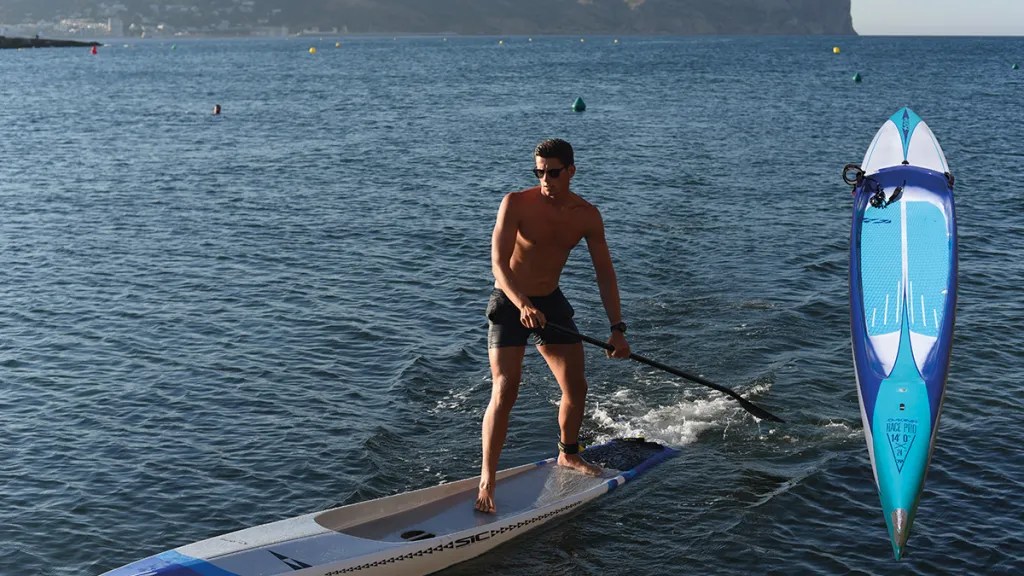
The quality of SUP equipment available to the average SUP enthusiast is incredible. Boards have become more and more specialised, lighter and narrower. Flat water boards are the fastest boards (which makes them so popular), but on the sea, only the top paddlers can get the best out of them. All water boards are more forgiving and are a great single choice for all-round use. However, downwind boards add a new dimension when downwinding, especially in more challenging conditions. I started using a SIC Bayonet recently and am so impressed with its ability in certain conditions.
I used a SIC Atlantis in the past, but I knew my skills needed to be improved to use it beyond a certain point. However, using a Bayonet, there is an unbelievable difference in performance (comparing the same person to the same conditions). The additional rocker and the upturned sharp nose make the board surge forward with every wave or swell. The narrow tail stops the waves from the back, pushing the rider offline. The small, narrow fin coupled with a very interesting hull makes the board more neutral in cross-chop. In short, if you want to get into downwind, invest in a downwind board.


Downwind racing
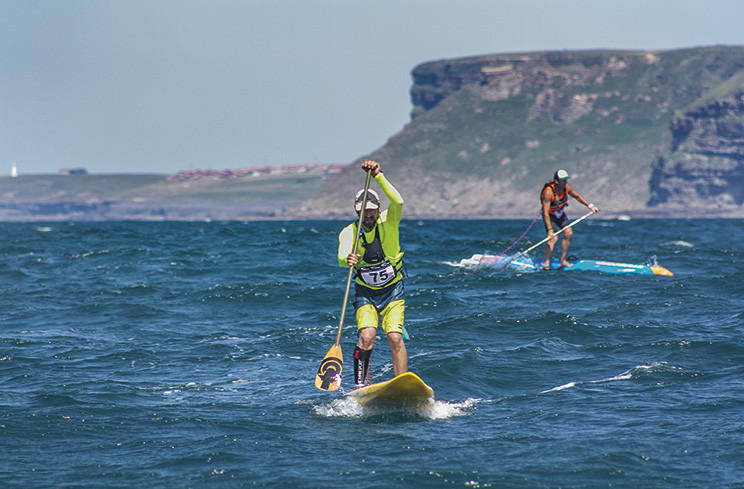
There are some world-renowned downwind races. Watch the Molokai on YouTube to see how the masters handle the open ocean. The fitness and skill required to complete this race is beyond 99.9 per cent of paddlers. But there are few downwinding races that mere mortals can enter.
My favourite occurs at the World SUP Festival, Santa Pola near Alicante. Unlike races on the flat, this race starts in one location and finishes at another. Downwind racing is entirely different to flat water. In flat water, you can always find someone to draft. You can always see what’s going on around you. A race strategy is apparent to you throughout the race. But in a downwind race, you can’t draft.
The field is spread over a wide sea area within a kilometre of the start. It’s tempting to try catching every wave and go hell for leather. But if you do this, you’ll join 40 per cent of the field who have done the same and burn themselves out with 4 km to go. You can’t watch the people around you because frustration can quickly take over, especially if they seem to be progressing better than you. No, you have to focus on your race, focus on the sea and catch the best waves minute by minute. It’s a massive mental challenge. These races remain with you as defining experiences of your SUP mentality.
Final words
Downwinding demands the entire skill set from the paddler. You find yourself in ‘flow’ when you challenge yourself to the extreme of your capabilities. You feel alive; you get a rush. You also grow in confidence and make step changes in your SUP ability.
Downwinding is a fascinating part of SUP. It’s a great experience to share with fellow paddlers and will leave you with lasting memories of achievement. It may take years to master, but improving over time is richly rewarding.
In short, ‘I love it!’
Andy Burrows is the author of the book ‘Improving your Stand Up Paddling.’ He spends most of his time living in Spain, where he paddles with some of the best in the world.
https://fernhurstbooks.com/books/permalink/172/improving_your_stand_up_paddleboarding

 SUP Mag UK
Leave a comment