Feel and timing to harness your paddling power

Words and photos: Andy Burrows
Timing is much talked about in ball sports such as tennis and golf. Watch a professional golfer and contrast their swing with a physically strong but uninformed novice. The professional creates a tempo that results in incredible club head speed, while the novice will try to swing as fast as they can and yet generate little power.
Club head speed is not a result of strength. The pro takes their body through an interconnected journey. They are relaxed, yet they create tension between different parts of their anatomy. They appreciate that the process occurs in phases over a particular time frame (i.e., backswing, pause, downswing, impact, and follow-through).
Timing in paddling is equally essential for performance. You can see timing in action when you watch a good paddler. The board surges with each stroke. In contrast, watch an amateur (without timing), and the board shows little evidence of acceleration between strokes.
I am amazed at how slow many paddlers are for the effort they put in. They might have nice boards and high-quality paddles, but without timing (integrated into sound technique), they are missing out. They are not getting a good return on their investment!
The SUP paddle stroke is quite a convoluted affair. Until you have been on a SUP, it’s not a movement you are likely to have practised. To help beginners develop technique, coaching models break the stroke into phases. This is useful because it makes the paddler aware of the separate movements necessary for a successful stroke. Once these movements become familiar (which takes a varying amount of time depending on physical capability and, dare I say, age), then the learning really begins.
Good golfers often discuss feel, while average golfers don’t. The same can be said of paddling. Tuning into feel takes awareness, but once you do, your timing will improve dramatically.
There are a set of paddlers who naturally have feel. Maybe they never experienced not having feel. These are generally the outstanding paddlers. But because it is almost intuitive, they are unaware of most of us who start paddling without a notion of feel.
I started paddling late in life. I had no experience of board sports and not a particularly good sense of balance. Consequently, my initial learning was mechanical. It was all about positions and copying what I could see. But I could not feel what good paddlers were feeling, and even when I asked them directly, they couldn’t answer – because it was all second nature to them. Perhaps this is a significant deficit in video coaching. The visual cues are necessary, but are they sufficient? Perhaps we need more of a focus on feel?
It is no accident that no two paddlers have an identical ‘style’. Every good paddler finds their own way. This probably relates to each being different physically and… mentally. So, learning by copying someone else will only get you so far. You have to employ sound principles but to advance into being good; you need to enter the realm of ‘feel’.


How can you improve your feel and, ultimately, your timing?
1. Heighten your awareness of what is taking place with each paddle stroke.
Spend time focussing on different parts of the body and what is taking place during the stroke. I start with my feet. I focus on where my weight is distributed over the feet and how it changes over the stroke cycle. I feel how the ankle and foot need to work together to flex and compensate. I sense the degree of tension or relaxation in the feet as I perform the stroke. Once I have spent some time on the feet, I work my way up my body, focussing on each part in turn and going through a similar process. Then, I try to feel how the whole body works together through the stroke cycle. Notice how one part will experience tension and another relaxation at the same time. I pay particular attention to what happens after the catch. This is best done by undertaking long, slow strokes.
2. Slowing the stroke down.
If you do this ‘properly’, it’s not easy. Get yourself into a powerful set position, and then insert the blade. When the blade is fully submerged, only then activate the body and sense the catch. It should feel like the blade is wedged in wet concrete. If this is what you feel, you will find you have to use your abdominals, glutes, and quads to drive the feet past the blade. It’s very difficult to get much forward motion from the upper body because you have no momentum. Try this by doing ten strokes on either side. Keep it slow. Don’t let the motion of the board allow you to cheat. Feel how the big muscles tighten and loosen together to create forward motion. Feel how the catch triggers the tension and the drive from the lower body.
3. Speed the stroke up.
Once you have done the routine in point 2, progress to taking very short, fast strokes. Maybe ten strokes either side and 40 in total. The stroke should finish well before the feet. Again, it takes work, and it can feel awkward. But you will discover how different this stroke feels and how differently your body responds to deliver it. The time in tension and relaxation is compressed. The rhythm is quite different. But you will find that this stroke is very effective at building and maintaining speed. Then, go back to the routine in point 2. The acute contrast in stroke length helps to build a greater sense of timing… that is to say, a sense of when to be relaxed and when to be ‘ready’ so that the power can be switched on (all together and at the same time).
4. Paddle into a headwind.
After undertaking the routines in 1,2, and 3, you should start to feel that your stroke is getting more powerful. The board should start to feel it is surging at each stroke. This is not because you have become stronger, but your timing has improved, and the power is happening in synchronicity. Then, you can test yourself by paddling into a strong headwind. This aspect is an excellent test of good timing. If you are keen to improve or just a bit of a masochist, go out and deliberately paddle into 25-knot winds. You will quickly find that the board flies when you return to normal conditions.
5. Create a visualisation that works for you.
There are various ways to do this. One method is to find videos of your favourite paddler and immerse yourself in their technique. By this, I mean try to imagine you are them, feeling the sensations they are feeling. Then, the next time you go out, take this onto the water. Replay the video in your head as you paddle, pretending to be them.
Visualising
Another method is to be very clear about the purpose of the paddle stroke. By this, I mean visualising that you are pushing your feet past your paddle, not pulling the paddle past your feet. Maintain this picture in mind as you paddle, and your body will do everything it can to create movements that do this. Beginners seldom appreciate this and probably visualise pulling a paddle behind them to go forward, with the consequent body movements associated with this.
Another visualisation I use is that the blade enters the water at an angle and at speed (but cleanly) and, therefore, lifts the front part of the board. This ‘lifting’ makes pushing the board ‘over’ the water easier with my feet (as in the main photo).
When a paddler develops good timing, they cannot only paddle faster and cope better with difficult conditions but also sustain a higher pace for longer and with less exertion. Feel and timing are two ingredients to integrate into the way you paddle.
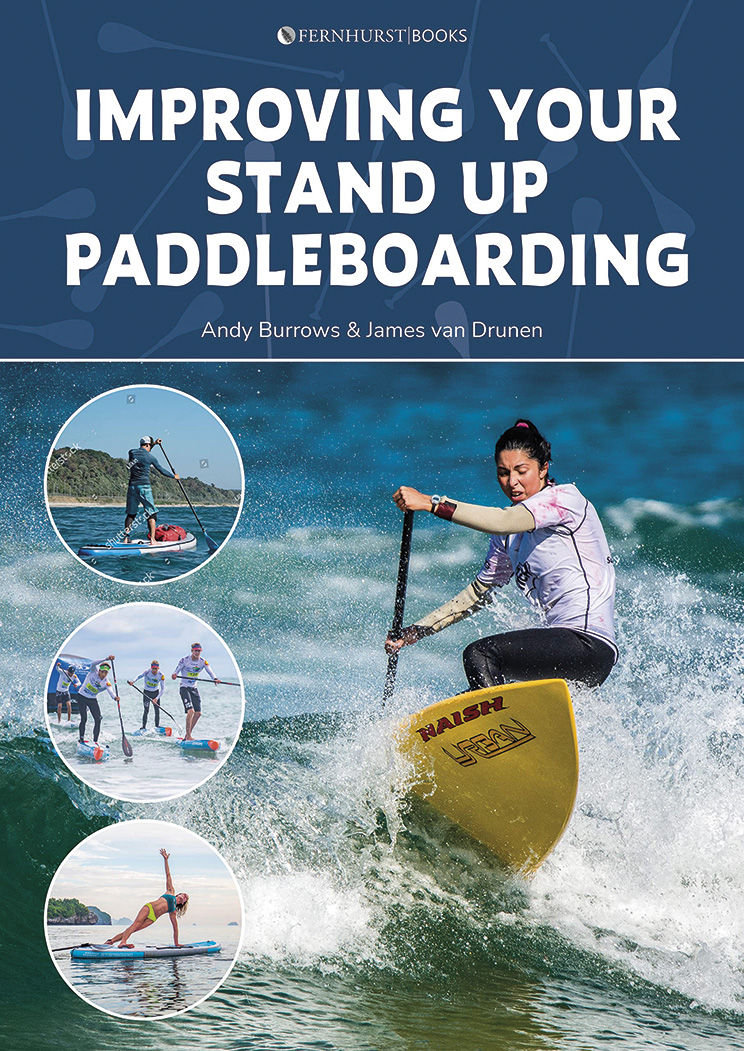
Andy Burrows is the author of the book ‘Improving your Stand Up Paddling.’ He spends most of his time living in Spain, where he paddles with some of the best in the world.
https://fernhurstbooks.com/books/permalink/172/improving_your_stand_up_paddleboarding

 SUP Mag UK
Leave a comment