WW river surfing

Words: Jim Miller
Photos: As stated
Many people have different interpretations of whitewater SUP. For some, it is touring; for some, it is big water; for some, it is technical rapids; and for a small minority, it is specifically surfing. However, surfing on a river can also take place on most river sections and is a regular form of enjoyment for all white water SUP paddlers.
During this article, we will examine what river surfing is, why it is something we should pay attention to when out on the rivers, some tips and tricks that will help us, and the equipment worth consideration.
What is river surfing
In a nutshell, river surfing is the ability to surf on a standing wave – a standing wave is a wave that remains in its place on the river due to changes within the river – this could be due to changes in the depth at that point, water running over obstacles, being re-circulated or sometimes even the width of the river changing in such a manner that it might form a wave. There are many similarities to surfing on the sea, but the wave does not move downriver; it stays in place. As such, surfing on a wave on the river is not always as uniform as the sea; the waves are choppy and variable, and one of the big luxuries is you can surf for a lot longer because the wave doesn’t disappear unless the river levels change. One of the wonderful things about river surfing is that we have the capacity to move around the wave more easily than on the sea, and we can go left or right, varying our balance and techniques as required.
Equipment:
Firstly, there are three main things equipment-wise to consider when river surfing. These are as follows:
The right type of board. There are many different boards on the market – but when it comes to river surfing, you need to consider two main different things: the first is the length of the board, and the second is the front and rear rocker on the board. When surfing, the length of the board has a big impact; by the very nature of a longer board, it gives you more scope to move and likely have more of the board contacting the water, which improves your stability on the wave but is harder to play on and turn. A shorter board is more playful and easier to turn, but due to less of the board contacting the water, you, of course, have less balance and stability on the wave. It is worth playing about initially with boards that have both front and rear rocker by are on the 9-10ft range, but when you get good and want to spice things up and go for tricks you should look at shortening the length of the board.
The right type of paddle. There are many different SUP paddles, but one of the main strokes we use when surfing is a low-brace support stroke. As such, a larger blade on the paddle will, by its nature, make for a much stronger brace and easier surf accordingly. So, if you are considering getting a surfing paddle, then look for one with a large blade.
Ensuring your safety is paramount when river surfing. It’s crucial to consider whether or not to wear any padding or protection. This is often overlooked, but it’s important to remember that falling off a SUP can be from a significant height into the water. River waves are often formed due to changes in the river bed, which could mean falling onto a shallower or rocky section. If you’re unsure about the depth of the river, it’s worth considering knee/shin or upper leg padding to reduce the risk of impact.


Tips for river surfing
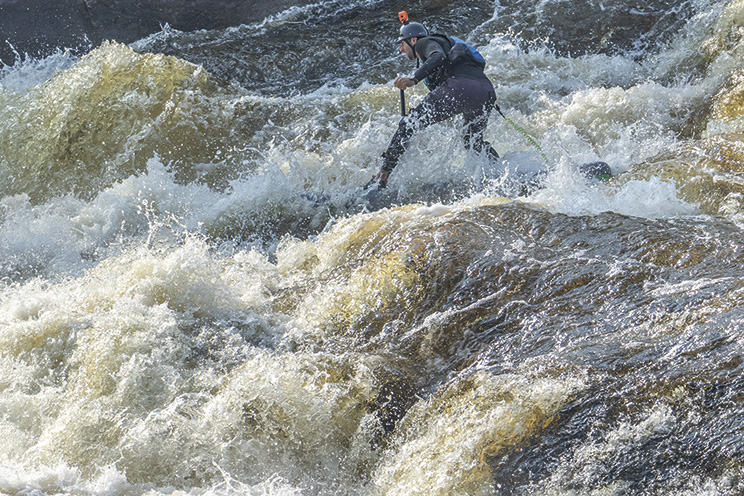
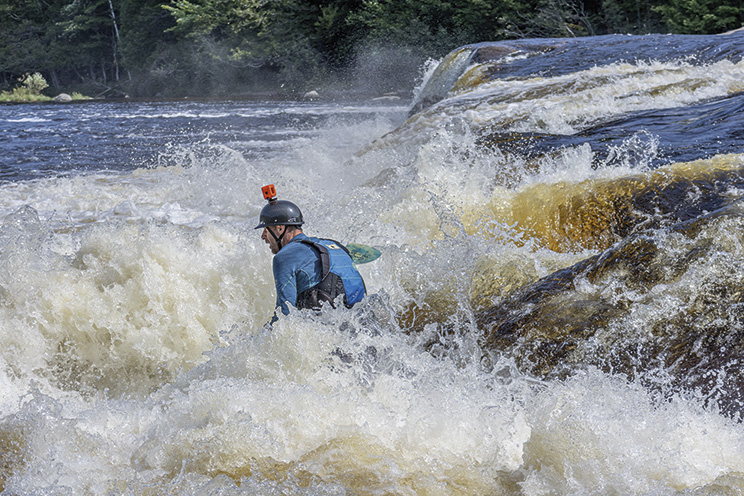
When river surfing, approaching the wave is one of the biggest things to consider, When you drop on from above, can you drift in sideways or on a rare occasion, you have to paddle up onto the wave from below, powering up the flow. In the best-case scenario, you can drift out of the eddy onto the wave. The trick to getting onto a wave is matching the speed of the water with the speed of your SUP. If you go too slow, you won’t make it; if you go too quickly, you overcook it and get shot off the front or back of the wave.
Once you have matched the speed of the wave, then you have to get the timing right to move your weight back on your SUP, ideally to have a foot on the kickpad. And another foot back from the centre of the board – this lifts the nose of the board and ensures that you can’t pearl the board. This has to be done with impeccable timing, as too early, and you are off the wave; too late, and your board pearls, and you go off the front of the board and are likely swimming. If you get this right, then you are now on the wave, and the fun begins!
From here, you want to ensure that you utilise a stern/low brace the majority of the time to stay balanced and the occasional correctional stroke like a rudder at the back of the board simply to change the direction subtly from left to right to move across the wave but at the same time as doing this you need to get used to transferring weight around your feet utilising the toes, heels and inside/outside edges of your board to put pressure in the right places on a SUP.
This feature is to give you a feeling of some of the techniques that help when surfing a wave, but it is by no means complete. Above all else, practice helps to make skills permanent, so we recommend getting out and having a practice!
What is Grade 5 on a SUP like?
When it comes to white water SUP, the majority of the people in the sport currently sit in and around the grade 2 bracket of white water. Few people progress above grade 3, but it is a very quickly growing discipline, and we can expect to see far more people paddling grade 3 over the coming years. Very few can SUP grade 4, and even fewer paddlers in the world can SUP grade 5! You can easily add a full grade to anything you paddle for SUP if you compare it to other sports. i.e. SUP on grade 5 is just as hard as kayaking grade 6!
The very few people who can SUP grade 5 are almost entirely sponsored – most are American, one is in the UK, and one or two are in Europe! There are three main reasons you do not see many people paddleboarding in and above grade 3 – for one, swimming in these environments is serious and can be fatal. The sport is still relatively new, and elite athletes have yet to develop, so there is the mental factor. It is easy to fall off a SUP, and you are at the height in huge whitewater, so not being cautious of this would be foolish!


The Upper Gauley
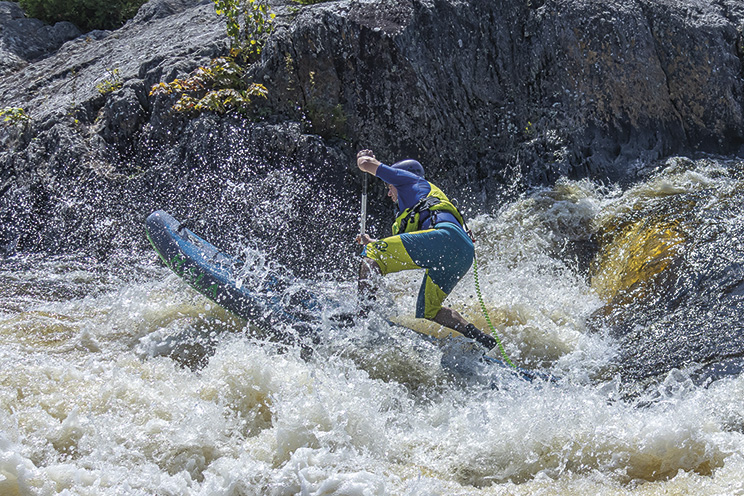
But the most likely contender for the current world’s hardest white water SUP done to date is the Upper Gauley in America. This river used to be grade 6 but has now been downgraded to 5 as equipment has developed. The Upper Gauley has been the site of many kayaking and rafting fatalities over the years, so even thinking of doing it on a SUP is crazy! But it has been done, and this year, three SUP boarders were doing it simultaneously. Almost nobody has attempted this, and trying to do this would be extremely dangerous!
The river consists of many rapids at grade 5 or higher, numerous grade 4 rapids, both named and unnamed and many grade 3/3+ rapids that are not even mentionable. The most serious rapid is Iron Ring, which used to be grade 6 but has since been downgraded. A swim here would be unthinkable, and as such, it is not worth the risk on a SUP. All the other rapids have been paddled on a SUP, one way or another.
In September of 2023, three Hala paddlers tackled the Upper Gauley – portaging Iron Ring, but between them, all paddling the other rapids. Each rapid comes with its unique problems. For example, Initiation has a terminal siphon on the right. Insignificant has huge waves/holes that are almost impossible to see until you are in them, and then a swim is less than pleasant, to say the least!
Iron curtain has undercuts you need to avoid and less than stable eddy lines. Pillow Rock has the room of doom and serious undercuts – so, don’t mess any of these up! Lost Paddle has huge undercuts, horrible rocks, big boils, and serious drowning potential. Tumblehome has serious siphons; Shipwreck has an undercut cave. The iron Ring has huge holes, sharp rocks, undercuts, risk of drowning, and incredibly hard lines on a SUP to make an unthinkable swim potential. Sweet Fall has a huge hole, undercut rocks, and a box canyon. Julies Juicer has a terminal hole; Woods Ferry has a horrible siphon – have we put you off yet?
Why would you SUP it?
Each of these rapids has potential lines, and most give you time to avoid the difficulties if you mess up a tiny bit. But if you take the wrong line, it will be game over. So why would you SUP it? Because the river itself is one of the best sections of easily accessible white water anywhere in the world, there are normally huge numbers of people on the rocks nearby who could help with some issues, to push the realms of the sport itself, to be social or perhaps because it is there. Each person’s reasons for attempting dangerous things are their own reasons. I love being on a SUP – and not afraid to portage things if required, do not paddle if I feels adrenaline rushes of any sort and want to continue helping to develop the sport in whatever way I can. I was in the United States for two weeks when I paddled the Upper Gauley. I’ve also paddled many other rivers and had the pleasure of having many highly experienced paddlers alongside me, as well as many different safety crafts and, on occasion, bank safety on some of the rapids.
Amazing and terrifying
In short, pushing the very realms of what is doable in any sport is both amazing and terrifying at the same time. There will always be people who do not think certain things should be done. While the majority of the community has been supportive of this trip, there have, of course, been people who have voiced negative feelings on the matter – but pushing the sport is how it develops and progresses and how we develop and progress as paddlers as well and for me, anything to help the sport of SUP is a true pleasure.
Will I go back? In future years, for sure! And I hope I can go back with even more experience and skills to stand for more of the features as, of course, I fell off on occasion!
About Jim Miller…
I began my love for the outdoors nearly 30 years ago when being taken up mountains, onto rivers and to the sea as a child. I would regularly run ahead into the mountains, sit on a rock and admire the views and this helped me to develop a true passion for the outdoor environment.
I regularly engage in all disciplines of paddlesports and have the privilege of being a national trainer for white water SUP and other disciplines as well as sitting on different discipline and technical committees. I am a provider in different SCA/BC awards which I deliver in canoe, kayak, SUP and rafts. I am currently on the Hala and Werner (System X) SUP teams for white water paddleboarding and love pushing the limits of what is possible. I am keen to share my passion and enjoyment with as many as possible and I love being on a SUP – a huge smile just crosses my face. I hope to see you all on the water at some point!

 SUP Mag UK
Leave a comment